




A Lewis & Clark Adventure With Katelyn - Page 5
| Previous | Page 1,2,3,4 |
 |
On our next and final day of following Lewis and Clark, we headed to Fort Clatsup near Warrenton, Oregon and then to Seaside, Oregon. Fort Clatsup is where Lewis and Clark ended up spending the winter of 1805/1806 until they began their return trip back on March 23, 1806. They had decided, after taking a vote among all of the party that they would move from Station Camp and head across to the south side of the Columbia River where they expected to find better protection from the weather and also more game, including elk, to feed them. The vote to do this was extraordinary because the officers of this expedition, Captain Lewis and Captain Clark, put the matter to a democratic vote of the entire party, and this included York (the black slave of Lewis) and Sacajawea (the Indian woman). The other options they had available to consider were to head back up river to a more protected area such as the Dalles or to a place called Sandy River. Instead, they voted to move across the river. To do that, they had to backtrack toward Pillar Rock to get away from wind and waves at the mouth of the river and then carefully navigate to the other side. Then they had to work their way back down the river to where Lewis had scouted out a place to set up camp. Altogether, this part of the trip took 12 days (from November 25 to December 7, 1805) in mostly wet and miserable weather. On December 7, 1805, Clark wrote: "... Some rain from 10 to 12 last night, this morning fair, have every thing put on board the Canoes and Set out to the place Capt Lewis had viewed and thought well Situated for winter quarters ... we proceeded on around the point [Smith Point, location of today's city of Astoria] into the bay [Young's Bay] and landed to take brackfast ... then proceeded around this Bay which I have taken the liberty of calling Meriwethers Bay the Cristian name of Capt. Lewis who no doubt was the 1st white man who ever Surveyed this Bay [actually, this bay was discovered, explored and named by Lieutenant William Robert Broughton of Vancouver's expedition on October 22, 1792], we assended a river [Lewis and Clark River] which falls in on the South Side of this Bay 3 miles to the first point of high land on the West Side, the place Capt. Lewis had viewed and formed in a thick groth of poine about 200 yards from the river, this situation is on a rise about 30 feet higher than the high tides leavel and thickly Covered with lofty poine. this is certainly the most eligable Situation for our purposes of any in its neighbourhood. ... Meriwethers Bay is about 4 miles across deep & receves 2 rivers the 'Kil how-a-nah-kle' [Young's River] and the 'Ne tul' [Lewis and Clark River] and Several Small Creeks. we had a hard wind from the N. E. and Some rain about 12 oClock to day wich lasted 2 hours sand Cleared away".
 |
 |
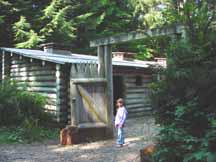
Today, the existing fort is a reproduction built from crude documents that survived, but it seems very authentic in its rustic architecture. It is said that the actual fort stood in the very same location where this one now stands, but the actual one may have been oriented to where its main entrance faced west instead of south. Katelyn enjoyed seeing the various rooms and visiting with the staff who were dressed in period costume. We took a short trail north of the camp, which lead us to a spring where the explorers obtained fresh drinking water. We also took a trail that stretched some 200 yards to the southeast where there was access to the river and some representative dugout canoes to look at. We then went to the visitor center where we saw a movie and looked at various exhibits. Altogether, Fort Clatsup is quite impressive, especially in the way the National Park Service has set it up to provide an educational experience. You can almost put yourself into the time period and visualize what it must have been like to exist in this place.
 |
 |
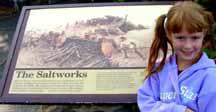
Next, we got in the car and headed southwest about 15 miles to Seaside, Oregon. This is where Lewis and Clark set up their Salt Works near the ocean beach to produce salt from the ocean. The journals from this part of their journey are very interesting. On December 28, 1805 Clark wrote: "Directed Drouilliard, Shannon, Labiche, Reuben Fields, and Collins to hunt; Joseph Fields, Bratton, Gibson to proceed to the ocean, at some convenient place form a camp, and commence making salt with 5 of the largest kettles, and Willard and Wiser to assist them in carrying the kettles to the seacoast."
On January 3rd he wrote: "Our party, from necessity having been obliged to subsist some length of time on dogs, have now become extremely fond of their flesh. It is worthy of remark that while we lived principally on the flesh of this animal, we were much more healthy, strong, and more fleshy than we had been since we left the buffalo country. For my own part, I have become so perfectly reconciled to the dog that I think it an agreeable food and would prefer it vastly to lean venison or elk."
On January 5th he writes: "At 5 P.M., Willard and Wiser returned. They had not been lost as we expected. They informed us that it was not until the fifth day after leaving the fort that they could find a convenient place for making salt; that they had at length established themselves on the seacoast about 15 miles S.W. from this, near the houses of some Clatsop and Tillamook families; that the Indians were very friendly and had given them a considerable quantity of the blubber of the whale which perished on the coast some distance S.E. of them. It was white and not unlike the fat of pork, though the texture was more spongy and somewhat coarser. We had part of it cooked and found it very palatable and tender. It resembles the beaver in flavor. Those men also informed us that the salt makers with their assistance had erected a comfortable camp, had killed an elk and several deer and secured a good stock of meat. They commenced the making of salt and found that they could make from 3 quarts to a gallon a day. They brought with them a specimen of the salt, of about a gallon. We found it excellent, white, and fine, but not so strong as the rock salt, or that made in Kentucky or the western parts of the U. States. This salt was a great treat to most of the party, having not had any since the 20th." I determined to set out early tomorrow with two canoes and 12 men in quest of the whale, or at all events to purchase from the Indians a parcel of the blubber. For this purpose I made up a small assortment of merchandise and directed the men to hold themselves in readiness."
On January 6th Clark writes: "The last evening Charbonneau and his Indian woman were very impatient to be permitted to go with me and were therefore indulged. She observed that she had traveled a long way with us to see the great waters and, now that monstrous fish was also to be seen, she thought it very hard that she could not be permitted to see either (She had never yet been to the ocean)."
On January 7th he writes: "I found our salt makers, and with them Sergeant Gass. George Shannon was out in the woods assisting Joe Fields and Gibson to kill some meat. The salt makers had made a neat, close camp, convenient to wood, salt water, and the fresh water of the Clatsop river, which at this place was within 100 paces of the oceans. They were also situated near four houses of Clatsops and Tillamooks, who, they informed me, had been very kind and attentive to them. I hired a young Indian to pilot me to the whale, for which service I gave him a file [files were used by the Indians to make tools and knives] in hand and promised several other small articles on my return. Left Sergeant Gass and one man of my party, Warner, to make salt, and permitted Bratton to accompany me."
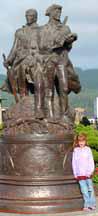
On January 8th he wrote: "Proceeded to the place the whale had perished. Found only the skeleton of this monster on the sand, between 2 of the villages of the Tillamook nation [this was near Cannon Beach, Oregon]. The whale was already pillaged of every valuable part by the Tillamook Indians in the vicinity, of whose villages it lay on the strand, where the waves and tide had driven up and left it. This skeleton measured 105 feet. I returned to the village of 5 cabins on the creek, which I shall call Ecola or Whale Creek. Found the natives busily engaged boiling the blubber, which they performed in a large, square wooden trough, by means of hot stones. The oil, when extracted, was secured in bladders and the guts of the whale. The blubber, from which the oil was only partially extracted by this process, was laid by in their cabins, in large flitches for use. Those flitches they usually expose to the fire on a wooden spit, until it is pretty well warmed through, and then eat it either alone or with roots of the rush, shanataque, or dipped in the oil. The Tillamooks, although they possessed large quantities of this blubber and oil, were so penurious that they disposed of it with great reluctance, and in small quantities only; insomuch that my utmost exertions, aided by the party, with the small stock of merchandise I had taken with me, were not able to procure more blubber than about 300 pounds and a few gallons of oil. Small as this stock is, I prize it highly; and thank Providence for directing the whale to us ..."
 |
On January 9th he wrote: "The persons who usually visit the entrance of this river for the purpose of traffic or hunting, I believe are either English or Americans. The Indians inform us that they speak the same language with ourselves, and give us proofs of their veracity by repeating many words of English, as musket, powder, shot, knife, file, damned rascal, son of a bitch, &c. Whether these traders are from Nootka Sound, from some other late establishment on this coast, or immediately from the U. States or Great Britain, I am at a loss to determine, nor can the Indians inform us. ... This traffic on the part of the whites consists in vending guns (principally old British or American muskets), powder, balls and shot, copper and brass kettles, brass teakettles and coffeepots, blankets from two to three points, scarlet and blue cloth (coarse), plates and strips of sheet copper and brass, large brass wire, knives, beads, and tobacco, with fishing hooks, buttons, and some other small articles. Also a considerable quantity of sailors' clothes, as hats, coats, trousers, and shirts. For these they receive in return from the natives dressed and undressed elk skins, skins of the seaotter, common otter, beaver, common fox, spuck, and tiger cat; also dried and pounded salmon in baskets, and a kind of biscuit which the natives make of roots, called by them shappellel. ... I had the blubber and oil divided among the party, and set out about sunrise and returned by the same route we had gone out. Met several parties of men and women of the Chinook and Clatsop nations on their way to trade with the Tillamooks for blubber and oil. On the steep descent of the mountain, I overtook five men and six women with immense loads of the oil and blubber of the whale. Those Indians had passed by some route by which we missed them as we went out yesterday. One of the women, in the act of getting down a steep part of the mountain, her load by some means had slipped off her back, and she was holding the load by a strap which was fastened to the mat bag in which it was in, in one hand and holding a bush by the other. As I was in front of my party, I endeavored to relieve this woman by taking her load until she could get to a better place a little below, and to my astonishment found the load as much as I could lift, and must exceed 100 pounds. The husband of this woman, who was below, soon came to her relief. Those people proceeded on with us to the salt works, at which place we arrived late in the evening. Found them without meat, and three of the party J. Fields, Gibson, and Shannon out hunting. As I was excessively fatigued, and my party appeared very much so, I determined to stay until the morning and rest ourselves a little. The Clatsops proceeded on with their loads. The Clatsops, Chinooks, Tilla- mooks, &c., are very loquacious and inquisitive. They possess good memories and have repeated to us the names, capacitiesof the vessels, &c., of many traders and others who have visited the mouth of this river. They are generally low in stature, proportionately small, rather lighter-complexioned, and much more illy formed than the Indians of the Missouri and those of our frontiers. They are generally cheerful, but never gay. With us, their conversation generally turns upon the subject of trade, smoking, eating, or their women. About the latter they speak without reserve in their presence -- of their every part, and of the most familiar connection. They do not hold the virtue of their women in high estimation, and will even prostitute their wives and daughters for a fishing hook or a strand of beads.
 |
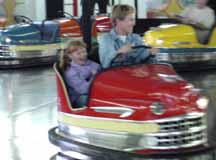 |
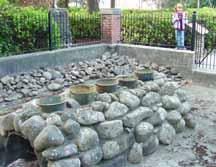
At the Salt Works, the hard working men produced about 3 1/2 bushels of salt by boiling many hundreds of gallons of seawater. They did this by building a large rock cairn that held 5 large brass kettles and contained a space beneath them for building a large hot fire. This salt was used to help season their food for taste, to help preserve their food, and to help prepare hides for clothing and blankets. On February 20, 1806 they abandoned this camp on the seacoast and the explorers then began to prepare for their return journey home. After seeing this, we too decided it was time to head back home, but not before taking in the rest of the sights of Seaside, Oregon. Dave took in a Volleyball Tournament on the beach, and Diana and Katelyn had fun in a bumper car at an amusement park facility.
| Previous | Top |